Disclosure: This article may contain affiliate links. We may earn a commission if you purchase through them, at no additional cost to you.
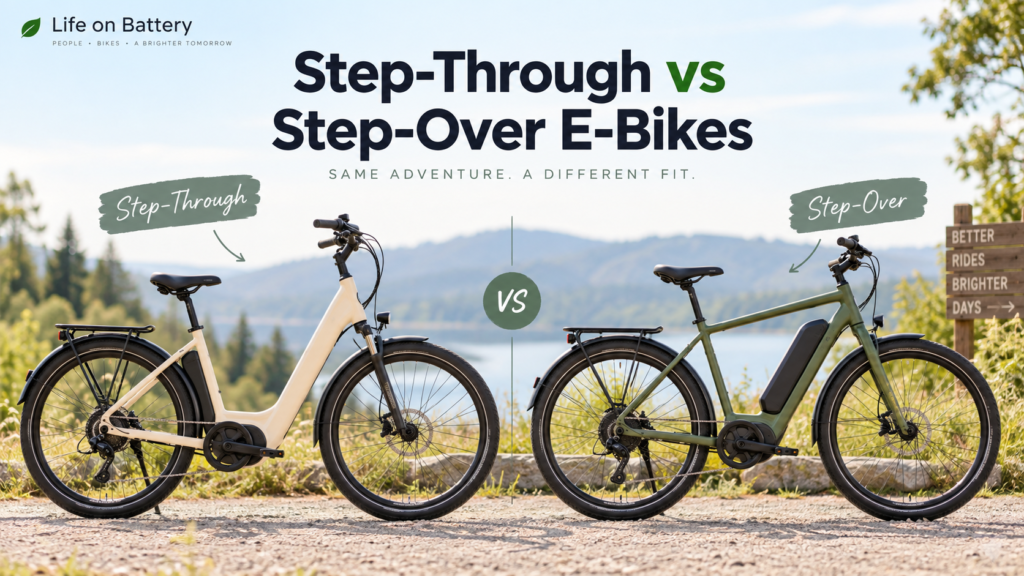
Step-through vs step-over e-bikes is one of the first choices many shoppers face when comparing electric bikes. The difference is easy to see in the frame, but it can affect comfort, mounting, stability, riding position, and how the bike feels in everyday use.
A step-through e-bike has a lower or more open frame that makes it easier to get on and off without swinging a leg high over the seat.
A step-over e-bike uses the more traditional bicycle frame with a higher top tube connecting the front and rear sections of the bike.
Neither design is automatically better for every rider. The right choice depends on your mobility, riding style, terrain, cargo needs, bike weight, and personal preference.
In this guide, we’ll compare the main differences between step-through and step-over e-bikes so you can decide which frame style is likely to fit you best.
What Is a Step-Through E-Bike?
A step-through e-bike uses a frame with a low or open center section, making it easier to get on and off the bike without lifting a leg high over the frame.
This design can be especially helpful for riders with limited flexibility, balance concerns, joint discomfort, or anyone who simply wants an easier mounting experience.
Step-through frames are also convenient for frequent stops. Commuters, delivery riders, recreational riders, and people carrying cargo may appreciate being able to step forward off the bike instead of swinging a leg over the seat.
Modern step-through e-bikes can still be strong and capable. Manufacturers use reinforced frame designs and larger tubing to provide stability while keeping the low-entry shape.
The tradeoff is that some step-through frames may be slightly heavier than comparable traditional frames because additional material can be needed to maintain strength.
What Is a Step-Over E-Bike?
A step-over e-bike uses the traditional bicycle frame shape with a higher top tube running between the front and rear sections of the bike.
To get on, the rider usually swings one leg over the saddle or frame. For riders with good flexibility and balance, this can feel completely natural.
Step-over frames are often associated with a more rigid frame structure because the top tube helps create a strong triangle between the front and rear of the bike.
That can make the design appealing for riders who want a more traditional bicycle feel, plan to ride on rougher terrain, or prefer a sportier frame style.
The main drawback is accessibility. A high top tube can make mounting and dismounting more difficult for riders with limited mobility, shorter inseams, balance concerns, or heavier e-bikes.
Step-Through vs Step-Over E-Bikes: Key Differences
The biggest differences between step-through and step-over e-bikes come down to accessibility, frame shape, riding feel, and intended use.
Mounting and dismounting: Step-through frames are generally easier to get on and off because the center of the frame is lower. Step-over bikes require the rider to lift a leg over the saddle or top tube.
Accessibility: Step-through bikes can be especially helpful for riders with limited flexibility, joint discomfort, balance concerns, or shorter inseams.
Frame rigidity: Step-over frames naturally form a stronger triangle, which can provide a more traditional and rigid bicycle feel. Step-through frames may use additional reinforcement to achieve similar strength.
Bike weight: Because of that extra reinforcement, some step-through bikes can weigh slightly more than comparable step-over models.
Riding style: Step-over bikes are often associated with sportier riding and rougher terrain, while step-through bikes are especially popular for commuting, casual riding, errands, and frequent stops.
Appearance: Some riders simply prefer the traditional look of a step-over frame, while others like the more open and practical design of a step-through.
For most everyday riders, the choice is less about which frame is “better” and more about which design feels easier and more comfortable to use.
Which E-Bike Is Easier to Get On and Off?
For most riders, a step-through e-bike is easier to get on and off because the frame has a lower opening between the handlebars and seat.
Instead of swinging a leg high over the saddle or top tube, the rider can step through the middle of the frame. That can make a noticeable difference with a heavier e-bike, especially when stopping frequently or balancing the bike at low speed.
This design may be particularly useful for riders with limited hip or knee flexibility, balance concerns, shorter inseams, or anyone who simply wants a more convenient way to mount and dismount.
Step-over bikes can still be easy to use for riders who are comfortable with the traditional frame style, but the higher top tube usually requires more flexibility and balance.
If ease of mounting is one of your main priorities, a step-through frame is usually the more practical choice.
Are Step-Through E-Bikes Less Stable?
Not necessarily. A well-designed step-through e-bike can feel very stable in normal riding, especially for commuting, recreational use, errands, and paved trails.
Because the frame does not use the same high top tube as a traditional step-over design, manufacturers may reinforce the frame in other ways to maintain strength and stiffness.
For everyday riding, most riders are unlikely to notice a major stability difference simply because the bike is step-through.
Other factors often matter more, including:
- Tire width
- Wheel size
- Bike weight
- Frame geometry
- Suspension
- Rider position
- Where the battery and motor are located
Riders who plan to ride aggressively on rough terrain may still prefer the traditional frame structure of a step-over bike, but for normal street and recreational riding, a quality step-through e-bike can be very stable.
Which Frame Style Is Better for Commuting?
For many commuters, a step-through e-bike can be the more convenient choice because it is easier to mount and dismount during frequent stops.
That can be especially useful in stop-and-go traffic, at intersections, when carrying a work bag, or when the bike is loaded with racks or cargo.
A step-through frame can also make it easier to start riding again after a stop because the rider does not have to swing a leg high over the bike.
A step-over e-bike can still be an excellent commuter, especially for riders who prefer a more traditional bicycle feel, sportier handling, or a lighter-feeling frame.
For commuting, the better choice usually comes down to comfort and convenience rather than speed. If you expect to get on and off the bike often, a step-through design may make daily riding easier.
Which Frame Style Is Better for Older Riders or Riders With Limited Mobility?
For many older riders or riders with limited mobility, a step-through e-bike can be easier and more comfortable to use because it requires less leg lift when getting on or off the bike.
That lower frame opening can be especially helpful for riders who have reduced hip or knee flexibility, balance concerns, or difficulty swinging a leg over a traditional top tube.
E-bikes are also heavier than many standard bicycles because of the motor and battery, so being able to step through the frame can make handling the bike at a stop feel more manageable.
A step-through design can also make it easier to put both feet on the ground quickly when stopping, depending on the bike’s frame geometry and seat height.
That does not mean every rider with limited mobility should automatically choose a step-through bike. Fit, weight, handlebar position, seat height, tire size, and overall balance are also important.
If possible, test ride the bike before buying and pay close attention to how easy it feels to mount, stop, turn, and get off the bike safely.
Which Frame Style Is Better for Carrying Cargo?
Both frame styles can work well for carrying cargo, but a step-through e-bike can be especially convenient when the bike is loaded.
With panniers, baskets, child seats, or a rear rack installed, swinging a leg over a traditional step-over frame can become more difficult. A low-entry frame lets the rider step through the bike instead.
That can make frequent stops, deliveries, errands, and grocery runs easier, especially when the bike is heavier than usual.
A step-over frame may still appeal to riders who want a more traditional feel or who regularly carry heavier loads over rough terrain.
For cargo use, pay attention to more than the frame style. Also compare the bike’s rack capacity, total weight limit, tire size, motor torque, braking system, and overall balance.
If you expect to carry cargo regularly, ease of mounting and dismounting can matter just as much as the bike’s carrying capacity.
Are Step-Through E-Bikes Only for Women?
No. Step-through e-bikes are not only for women.
The low-entry frame design is simply a practical way to make getting on and off the bike easier. Riders of any gender may prefer a step-through frame because of comfort, mobility, convenience, or frequent stopping.
The idea that step-through bikes are “women’s bikes” comes from older bicycle designs and marketing traditions, not from any technical limitation of the frame.
Today, step-through e-bikes are commonly used by commuters, older riders, delivery riders, recreational cyclists, and people carrying cargo.
When choosing an e-bike, frame fit, comfort, weight, riding position, and intended use matter much more than whether the bike is marketed toward men or women.
Which Frame Style Is Better for Rough Terrain?
For rougher terrain, many riders may prefer a step-over e-bike because the traditional frame shape can provide a more rigid feel and is commonly used on mountain and off-road bikes.
That does not mean a step-through e-bike cannot handle rough roads or trails. Many modern step-through models use reinforced frames, wider tires, suspension, and strong braking systems that make them capable on uneven surfaces.
The better choice depends on how aggressive the riding will be. For paved roads, gravel paths, park trails, and light recreational riding, either frame style may work well.
For more demanding off-road riding, steep terrain, or higher-speed trail use, riders may prefer the traditional frame structure and riding position of a step-over design.
Frame style is only one part of the decision. Tire width, suspension travel, wheel size, motor power, brakes, and overall bike geometry can matter just as much when riding on rough terrain.
Example to consider: The Kingbull Hunter 2.0S is a step-over fat-tire e-bike designed for mixed terrain, with a 750W motor, 864Wh battery, hydraulic brakes, and 26 × 4-inch tires.
Does Frame Style Affect E-Bike Range?
Frame style by itself usually does not have a major direct effect on e-bike range.
A step-through and a step-over bike with the same battery, motor, rider, tires, and riding conditions could have very similar range.
However, frame style can affect range indirectly because it may influence other things such as:
- Bike weight
- Riding position
- Aerodynamics
- Tire size and width
- Cargo capacity
- Overall frame design
For example, a heavier bike or a more upright riding position may use slightly more energy in some conditions, while a lighter or more aerodynamic setup may be somewhat more efficient.
In everyday riding, though, factors such as assist level, hills, rider weight, wind, tire pressure, speed, and battery capacity usually have a much bigger effect on range than whether the frame is step-through or step-over.
So if range is one of your biggest concerns, focus more on the battery size, motor system, bike weight, terrain, and riding habits than on frame style alone.
Which Frame Style Is Easier to Transport or Store?
Frame style usually matters less for transport and storage than the bike’s overall weight, wheel size, handlebar width, and whether the frame or handlebars fold.
Step-through e-bikes can sometimes be easier to handle when loading or unloading because the open frame gives you more ways to grab and balance the bike.
Step-over bikes may feel slightly easier to lift in some situations because the top tube provides a convenient handhold.
Either style can be difficult to transport if the e-bike is heavy, so it is important to check the bike’s total weight before buying.
If you plan to carry the bike on a vehicle rack, also make sure the rack is rated for the weight of an e-bike and is compatible with the frame shape.
For storage, consider the bike’s total length, handlebar width, battery removability, and whether you need to move it up stairs or through narrow spaces.
Step-Through vs Step-Over E-Bikes: Which One Should You Choose?
The right frame style depends mostly on how you plan to ride and what feels easiest and most comfortable for you.
A step-through e-bike may be the better choice if you want:
- Easier mounting and dismounting
- More convenience during frequent stops
- A lower frame for mobility or flexibility concerns
- Easier access when carrying cargo
- A more relaxed everyday riding experience
A step-over e-bike may be the better choice if you want:
- A more traditional bicycle frame
- A sportier riding feel
- A frame style commonly used for rougher terrain
- A higher top tube that can make the bike easier to lift in some situations
For many everyday riders, especially commuters and recreational riders, comfort and ease of use matter more than the label on the frame.
If possible, test ride both styles before buying. Even two bikes with the same general frame type can feel very different because of seat height, handlebar position, wheel size, bike weight, and overall geometry.
Frequently Asked Questions About Step-Through and Step-Over E-Bikes
Are step-through e-bikes harder to pedal?
No. The frame style itself does not make an e-bike harder to pedal. Pedaling effort depends more on the bike’s motor assistance, gearing, weight, tire size, terrain, and riding conditions.
Are step-over e-bikes stronger than step-through models?
Step-over frames naturally use a traditional triangle shape that can provide excellent rigidity. Modern step-through frames can also be very strong because manufacturers reinforce the frame in other ways.
Are step-through e-bikes heavier?
Sometimes. A step-through frame may require extra reinforcement, which can add some weight. However, the total weight of an e-bike also depends on the battery, motor, tires, suspension, accessories, and frame materials.
Can tall riders use a step-through e-bike?
Yes. Step-through e-bikes are available in different frame sizes and geometries. Tall riders should pay attention to the manufacturer’s recommended rider-height range, seat adjustment, and reach to the handlebars.
Can short riders use a step-over e-bike?
Yes, as long as the frame fits properly. Shorter riders should pay close attention to stand-over height and make sure they can comfortably control the bike when stopping.
Is a step-through e-bike good for beginners?
It can be. The easier mounting and dismounting can make a step-through bike feel less intimidating, especially for someone new to heavier electric bikes.
Bottom Line: Step-Through vs Step-Over E-Bikes
Step-through and step-over e-bikes can both be excellent choices, but they serve riders a little differently.
A step-through e-bike is usually easier to mount and dismount, which can make it especially practical for commuters, older riders, riders with limited mobility, and anyone who makes frequent stops.
A step-over e-bike offers the more traditional bicycle frame style and may appeal more to riders who prefer a sportier feel or expect to ride on rougher terrain.
The best choice depends on comfort, mobility, frame fit, bike weight, riding style, and how you plan to use the bike.
If possible, test ride both frame styles before buying. The bike that feels easiest to control, stop, mount, and ride comfortably is usually the better choice for you.
Related reading: Learn how long an e-bike battery lasts and how long it takes to charge an e-bike battery.