Disclosure: This article may contain affiliate links. We may earn a commission if you purchase through them, at no additional cost to you.
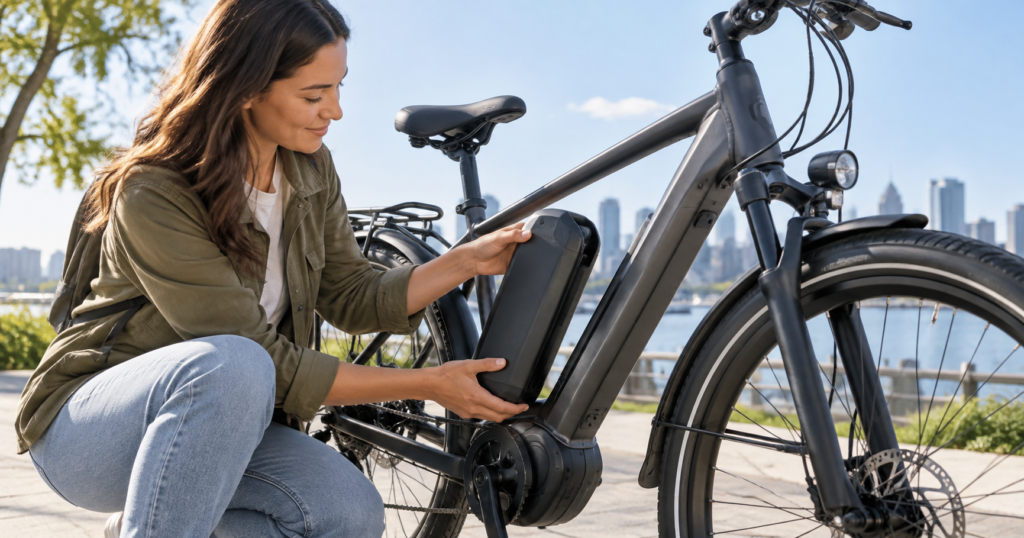
If you’re considering an e-bike, the battery is one of the most important—and often most confusing—parts of the purchase. How far can you ride on one charge? How many years should the battery last? And what can you do to keep it working well for as long as possible?
There isn’t one answer that fits every e-bike. Battery capacity, assistance level, terrain, rider and cargo weight, temperature, tire pressure, and riding habits can all affect range. Battery age and the way it is charged and stored also affect long-term lifespan.
In this guide, we’ll break those factors down in plain English so you can better understand what to expect from an e-bike battery before you buy—and how to care for one after you do.
What Does “E-Bike Battery Life” Actually Mean?
When people talk about “e-bike battery life,” they usually mean one of two different things:
1. Range per charge — how far the bike can travel before the battery needs to be recharged.
2. Long-term battery lifespan — how many years and charging cycles the battery can deliver useful capacity before its performance noticeably declines.
These are related, but they are not the same thing. A battery can still be healthy overall while delivering fewer miles on a cold day, a hilly route, or when the rider is using a higher level of motor assistance.
Over the longer term, lithium-ion batteries gradually lose some of their original capacity as they age and are used. That means an older battery may still work normally, but it may not take you as far on a charge as it did when it was new.
Manufacturers also measure battery life in charging cycles. The exact expected lifespan varies by battery design, riding conditions, charging habits, temperature, storage, and the manufacturer’s battery-management system.
So when evaluating an e-bike, it helps to ask two separate questions: How far will this battery take me today? and How well is it likely to hold its capacity over the years?
How Many Miles Can an E-Bike Go on One Charge?
There is no single mileage number that applies to every e-bike. A useful general expectation for many everyday e-bikes is roughly 25 to 60 miles per charge, but real-world range can be lower or higher depending on the bike and how it is ridden.
Some newer long-range models advertise considerably more. For example, current Aventon commuter models list ranges from about 60 miles up to 110 miles under favorable conditions. Manufacturer range claims are best treated as estimates rather than guarantees because actual results can change with terrain, rider weight, assist level, throttle use, wind, temperature and stop-and-go riding.
Battery capacity is one of the biggest clues. E-bike batteries are commonly rated in watt-hours (Wh). In general, a larger watt-hour number means the battery stores more energy and can support a longer ride, all else being equal. Current Bosch systems, for example, include batteries ranging from about 400 Wh to 800 Wh, while some Specialized e-bikes use batteries around 840 Wh or more.
The most important thing to remember is that advertised range is usually measured under specific test conditions. Real-world riding may be different. If your daily round trip is 20 miles, it is usually smarter to choose a bike with more than 20 miles of claimed range so you have a comfortable reserve.
What Affects E-Bike Battery Range?
Several things can change how far an e-bike travels on a charge. The biggest factors are usually:
Assist level. Higher assist settings ask the motor to do more work, which generally uses battery energy faster. Lower-assist or Eco modes usually extend range. Shimano specifically notes that reduced assist output tends to increase traveling distance.
Hills and terrain. Climbing requires much more motor assistance than riding on flat ground, so hilly routes can reduce range substantially. Rough or soft surfaces can also require more energy.
Rider, cargo and bike weight. More total weight means the motor has to work harder, especially when accelerating or climbing. Shimano notes that lighter riders generally require less power than heavier riders at the same climbing speed.
Temperature. Cold weather can temporarily reduce battery performance and range. Shimano specifically lists cold conditions as a factor that can shorten how long a charge lasts.
Tire pressure and rolling resistance. Properly inflated tires generally roll more efficiently. Bosch includes tire type, road surface and riding conditions among the factors that affect expected range.
Riding style. Frequent stops, hard acceleration, high speeds and heavy motor use can consume more energy than steady riding. Proper gear selection and cadence can also help reduce unnecessary motor assistance.
This is why two riders on the same model of e-bike can get noticeably different mileage from identical batteries.
How Many Years Does an E-Bike Battery Last?
An e-bike battery does not suddenly become unusable after a certain number of years. Instead, lithium-ion batteries gradually lose some of their ability to store energy as they age and go through charging cycles.
That is why charge cycles can be more useful than years alone when judging battery lifespan. Shimano states that some of its e-bike batteries retain more than 60% of their original maximum capacity after 1,000 full charges. In other words, the battery can still function after many hundreds of charging cycles, although its riding range may eventually be lower than when it was new.
How quickly that capacity declines depends heavily on how the battery is used and stored. Bosch notes that e-bike batteries age even when they are not being used, and that heavy use, high storage temperatures, direct sunlight, and long periods stored completely full or completely empty can shorten service life.
For most riders, the practical question is not simply, “How old is the battery?” but rather, “How much useful capacity does it still have?” A battery that still provides enough range for your normal rides may remain useful even after its original capacity has declined somewhat.
How Can You Make an E-Bike Battery Last Longer?
Good battery care will not stop normal aging, but it can help slow unnecessary capacity loss and keep the battery useful longer.
Avoid extreme heat. High temperatures are hard on lithium-ion batteries. Bosch notes that prolonged storage above about 30°C (86°F) can shorten service life, while cooler storage conditions are better for long-term battery health.
Do not store the battery completely full or completely empty for long periods. Bosch recommends partial charge for storage, and Shimano recommends about 70% charge when storing an e-bike battery for an extended period.
Store it somewhere cool and dry. Shimano recommends a stable indoor temperature of roughly 10°C to 20°C (50°F to 68°F) and keeping the battery away from direct sunlight.
Do not leave a fully discharged battery sitting for months. Shimano warns that a battery left completely discharged can continue degrading and may eventually become difficult or impossible to recharge.
Use the correct charger. Use the charger specified by the bike or battery manufacturer rather than an unapproved substitute. Shimano specifically instructs owners to use the designated charger for its lithium-ion batteries.
Check the battery during long-term storage. Shimano recommends recharging a stored battery to around 70% about every six months so it does not become deeply discharged.
The best routine is usually simple: avoid excessive heat, do not neglect a fully discharged battery, follow the manufacturer’s storage instructions, and use the approved charging equipment.
When Should You Replace an E-Bike Battery?
You do not necessarily need to replace an e-bike battery just because it is several years old. Replacement usually makes sense when the battery no longer provides enough useful range for your normal riding, will not charge properly, or shows signs of damage or failure.
Reduced range. If a battery that once handled your normal trip comfortably now needs frequent recharging, its usable capacity may have declined enough that replacement is worth considering.
Charging problems or error warnings. If the battery will not charge normally, repeatedly shows errors, or stops powering the bike properly, have the system checked by an authorized dealer before assuming the battery simply needs replacing.
Visible damage. Do not continue using a battery that is cracked, badly dented, water-damaged, swollen, leaking, or otherwise visibly damaged. Bosch specifically warns against using damaged e-bike batteries because of fire and explosion risk.
After a serious impact. A battery that has been involved in a crash or hard impact should be inspected before continued use, even if the damage is not obvious.
When the remaining capacity no longer fits your needs. A battery does not have to be completely “dead” before replacement makes sense. If its reduced range is making the bike impractical for your commute or regular rides, that may be the point when replacement becomes worthwhile.
When replacing an e-bike battery, use a battery approved for the specific bike and drive system. Do not attempt to open or repair a lithium-ion e-bike battery yourself.
Is It Safe to Charge an E-Bike Battery Overnight?
The safest answer is no — do not charge an e-bike battery while you are asleep or away from home.
The U.S. Consumer Product Safety Commission advises people to be present while charging micromobility products such as e-bikes and e-scooters and specifically says not to charge them while sleeping. CPSC notes that a number of lithium-ion battery fires and deaths have occurred at night while batteries were charging and occupants were asleep.
Use only the charger supplied with the e-bike or one specifically approved by the manufacturer. CPSC and UL Solutions both warn against using incompatible chargers or unapproved replacement batteries because the battery, charger and electrical system are designed to work together.
Charge the battery in a dry area away from flammable materials and where it will not block an exit. Follow the manufacturer’s charging instructions and unplug the charger when charging is complete.
If a battery becomes unusually hot, changes shape, leaks, gives off an unusual odor, or makes abnormal noises, stop using it and follow the manufacturer’s safety instructions.
A properly designed e-bike battery system includes protective electronics, but that does not eliminate the need for safe charging habits.
What Should You Look for When Buying an E-Bike Battery System?
When comparing e-bikes, don’t look only at the advertised riding range. The battery system itself deserves just as much attention as the motor, frame and price.
Battery capacity. Look at the battery’s watt-hour (Wh) rating. A larger Wh number generally means more stored energy and potentially more range, although terrain, assist level, rider weight and other factors still matter.
Safety certification. Look for an e-bike electrical system that is certified to a recognized safety standard such as UL 2849. UL 2849 evaluates the complete electrical drive system, including the battery and charger working together. UL 2271 applies specifically to batteries used in light electric vehicles.
Be careful with wording such as “tested to UL standards.” UL explains that being tested to a standard is not necessarily the same as being independently certified. A legitimate certification can be verified through the certifying laboratory.
Replacement battery availability. Before buying the bike, check whether the manufacturer sells replacement batteries and what they cost. A bargain e-bike may become far less attractive if a compatible replacement battery is difficult to obtain several years later.
Warranty coverage. Read the battery warranty separately from the bicycle warranty. Check how long the battery is covered and whether the warranty includes limits based on charge cycles or remaining capacity.
Charger compatibility. Use the charger intended for that particular battery system. UL notes that the battery and charger are designed to work together and recommends using the charger supplied with the e-bike.
Manufacturer support. A company with replacement parts, clear manuals and accessible customer support may be worth paying more for, especially because the battery is one of the most expensive components on an e-bike.
A good e-bike purchase is not just about how far the bike can travel when it is new. It is also about whether the battery system can be safely charged, maintained and replaced throughout the years you expect to own the bike.
The Bottom Line: How Long Can You Expect an E-Bike Battery to Last?
An e-bike battery can remain useful for years, but there is no single lifespan that applies to every rider or every battery.
A newer battery may deliver many dozens of miles per charge, while an older battery may gradually lose some of that range over time. How quickly that happens depends on the battery design, number of charging cycles, temperature, storage conditions, riding habits and how well the system is maintained.
The best approach is to think about battery life in two ways: how much range you need today and how well the battery is likely to serve you over the years you plan to own the bike.
Choose an e-bike with enough battery capacity for your normal riding, follow the manufacturer’s charging and storage instructions, use approved charging equipment, and pay attention to replacement battery availability and safety certification.
With sensible care, an e-bike battery can provide a lot of useful riding before reduced capacity makes replacement worthwhile.
Frequently Asked Questions About E-Bike Batteries
How often should I charge my e-bike battery?
Charge it when needed rather than worrying about following a rigid schedule. Modern lithium-ion batteries do not need to be completely discharged before recharging. Follow the manufacturer’s instructions for your particular battery and charger.
Can I charge an e-bike after every ride?
Generally, yes. You do not have to wait until the battery is nearly empty before charging it. If the bike will be stored for a long period, however, follow the manufacturer’s recommended storage charge level rather than leaving it fully charged or completely discharged for months.
Does cold weather permanently damage an e-bike battery?
Cold temperatures can temporarily reduce available range and performance. Normal performance often improves again as the battery warms, but long-term storage and charging should follow the temperature limits specified by the manufacturer.
Is a bigger e-bike battery always better?
Not necessarily. A larger battery can provide more energy and potentially more range, but it may also add weight and cost. The better choice is a battery with enough capacity for your typical rides plus a reasonable reserve.