Disclosure: This article may contain affiliate links. We may earn a commission if you purchase through them, at no additional cost to you.
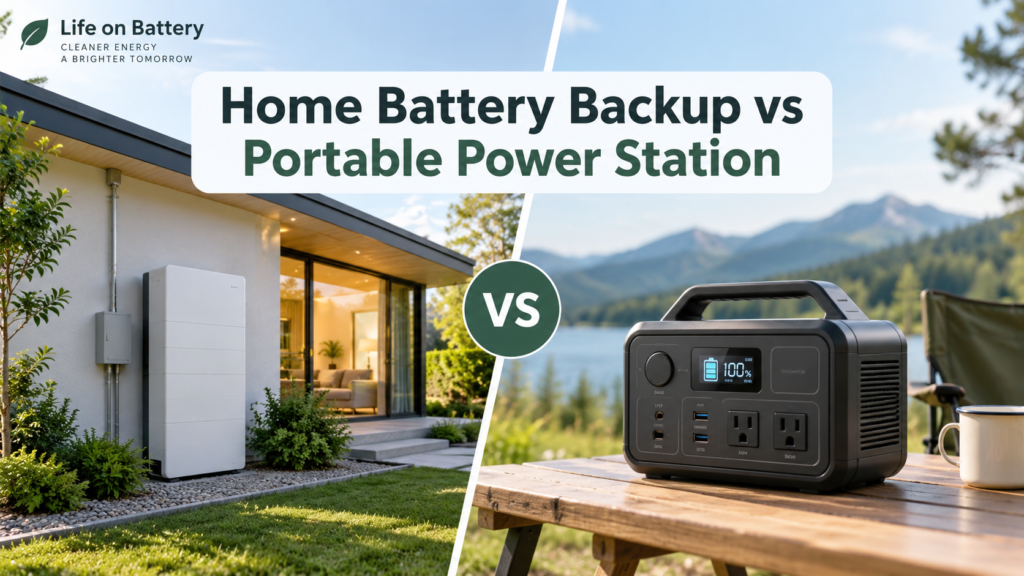
Home battery backup vs portable power station systems can both keep important devices running when the power goes out, but they are designed for very different jobs.
A portable power station is usually a self-contained battery you can move from place to place. It can power selected appliances, electronics, tools, camping equipment, or even an e-bike charger.
A home battery backup system is much larger and is designed to support part or all of a home’s electrical system. These systems are generally installed permanently and can work automatically when utility power fails.
The right choice depends on what you want to power, how long you need backup energy, whether you want something portable, and how much you are prepared to spend.
In this guide, we’ll explain the main differences between home battery backup systems and portable power stations, what each one does best, and when one may make more sense than the other.
What Is a Portable Power Station?
A portable power station is a rechargeable battery system that stores electricity and provides power through AC outlets, USB ports, and sometimes DC connections.
Unlike a permanently installed home battery, a portable power station can usually be moved wherever you need it. Depending on the size, it might power phones and laptops, run a refrigerator for a period of time, operate small appliances, charge an e-bike, or support camping and RV equipment.
Portable power stations are commonly rated in watt-hours (Wh), which tells you how much energy the battery can store, and watts (W), which tells you how much power the unit can deliver at one time.
Smaller units may hold a few hundred watt-hours, while larger portable systems can exceed 1,000 Wh and may support expansion batteries for additional capacity.
Many newer models use LiFePO₄ battery chemistry, which is designed for long cycle life and frequent charging. Some models can also recharge from household power, a vehicle, or compatible solar panels.
The main advantages are flexibility and portability. The tradeoff is that even a large portable power station generally stores much less energy than a permanently installed whole-home battery system.
What Is a Home Battery Backup System?
A home battery backup system is a larger energy-storage system designed to provide electricity to part or all of a home during a power outage.
Unlike a portable power station, a home battery is usually installed permanently and connected to the home’s electrical system. Depending on the design, it may power selected circuits or provide broader backup for major household loads.
Many home battery systems can automatically detect a utility outage and begin supplying stored power without the homeowner having to plug individual devices into the battery.
These systems are typically measured in kilowatt-hours (kWh) rather than watt-hours because they store much more energy than most portable power stations. Some systems can also be expanded with additional battery capacity.
Home batteries may be charged from the electrical grid, solar panels, or a combination of both, depending on the system and installation.
The biggest advantages are convenience, larger capacity, and automatic backup capability. The tradeoffs are higher cost, professional installation, and the fact that the system stays with the home rather than traveling with you.
Home Battery Backup vs Portable Power Station: Key Differences
Home battery backup systems and portable power stations both store electricity, but they differ significantly in size, installation, portability, and what they are designed to power.
Capacity: Home battery systems usually store far more energy than portable power stations. Portable units are often measured in hundreds or a few thousand watt-hours, while home batteries are commonly measured in multiple kilowatt-hours.
Installation: Portable power stations are generally plug-and-play. Home battery systems are usually permanently installed and connected to the home’s electrical system.
Portability: A portable power station can travel with you. A home battery stays with the house.
Automatic backup: Many home battery systems can switch on automatically during an outage. Portable power stations usually require you to plug devices or appliances into them manually.
Powering large loads: Home battery systems are better suited for larger household loads and multiple circuits. Portable systems are usually better for selected appliances, electronics, tools, or short-term backup.
Cost: Portable power stations are generally much less expensive to buy and use. Whole-home battery systems can cost significantly more because of the larger battery capacity, electrical equipment, and professional installation involved.
Flexibility: Portable power stations can be used at home, in an RV, at a campsite, or while traveling. Home battery systems are designed specifically for the property where they are installed.
When Does a Portable Power Station Make More Sense?
A portable power station may make more sense when you want backup electricity without installing a permanent system in your home.
It can be a good fit for shorter outages, especially when your main goal is to keep selected devices running rather than power the entire house.
Portable power stations can also be useful for people who want one battery system to serve several purposes, such as:
- Keeping phones, laptops, lights, or internet equipment running during an outage
- Powering a refrigerator or small appliance for a limited period
- Charging an e-bike or other battery-powered equipment
- Camping or RV travel
- Providing temporary power in a garage, workshop, or outdoor area
Another advantage is that you can start with a smaller system and move up to a larger model later if your needs change.
A portable power station may also be easier to justify if you rent your home or do not want to invest in electrical installation work.
The main limitation is capacity. If your goal is to keep major household systems running for a long outage, a portable unit may not provide enough stored energy or output on its own.
When Does a Home Battery Backup System Make More Sense?
A home battery backup system makes more sense when you want a more permanent solution that can support larger household loads and work automatically during an outage.
It may be a better fit if your goals include:
- Keeping several important home circuits powered at the same time
- Supporting major appliances for longer periods
- Having backup power start automatically when the grid goes down
- Pairing battery storage with rooftop solar
- Reducing dependence on portable generators
- Building a long-term backup-power system for the home
Home battery systems are especially attractive for homeowners who experience frequent outages or who want backup power available without moving equipment or running extension cords through the house.
The main drawback is cost. A permanently installed system usually requires a larger upfront investment, electrical work, and professional installation.
For some homeowners, that higher cost is justified by the convenience, larger capacity, and automatic operation. For others, a portable power station may provide enough backup capability at a much lower cost.
How Much Backup Power Do You Actually Need?
The amount of backup power you need depends on what you want to keep running and how long you expect an outage to last.
Start by listing the devices and appliances that matter most during an outage. For many households, that might include:
- Refrigerator or freezer
- Internet modem and router
- Phones and laptops
- Lights
- Medical or accessibility equipment
- Fans or small appliances
Then look at two numbers: power draw in watts and energy use over time.
A device that uses 100 watts for 5 hours would consume about 500 watt-hours (Wh) of energy. Larger appliances and longer runtimes can raise that total quickly.
This is why a small portable power station may be enough for phones, lights, and internet equipment, while a larger home battery system may be necessary if you want to support multiple appliances or major household loads for an extended outage.
It is also smart to leave some extra capacity instead of sizing a backup system to the exact minimum. Real-world energy use can vary, and batteries do not usually deliver every watt-hour printed on the label because of normal conversion losses.
Can a Portable Power Station Back Up a Refrigerator?
Yes, many portable power stations can run a refrigerator for at least part of an outage, but the actual runtime depends on the refrigerator’s power use and the size of the power station.
Refrigerators do not usually draw their maximum wattage continuously. The compressor cycles on and off, so average energy use over several hours can be much lower than the startup surge.
The two numbers to compare are:
- Continuous AC output — the power station must be able to handle the refrigerator while it is running.
- Battery capacity in watt-hours — this determines roughly how long the refrigerator can be powered.
A larger power station with around 1,000 Wh or more may be able to keep a typical refrigerator running for several hours, while smaller units may only provide limited backup time.
Startup surge also matters. Refrigerators can briefly draw much more power when the compressor starts, so the power station should have enough surge capacity as well as enough continuous output.
For longer outages, a refrigerator can use a large portion of a portable power station’s stored energy, especially if you are also powering lights, internet equipment, phones, or other appliances at the same time.
Can a Portable Power Station Run Air Conditioning?
Sometimes, but air conditioning is one of the more demanding loads for a portable power station.
A small window or portable air conditioner may be able to run from a sufficiently powerful battery station, but you need to check both the unit’s running wattage and its startup surge.
Air conditioners can briefly require much more power when the compressor starts. A power station that appears large enough based only on normal running wattage may still shut down if it cannot handle that surge.
Battery capacity is another major factor. Even if a power station can start and run an air conditioner, cooling equipment can consume stored energy quickly. A roughly 1,000 Wh portable power station may therefore provide much less runtime for air conditioning than it would for a refrigerator, lights, or electronics.
Central air conditioning is a different situation. Most whole-home systems require much higher power, and many use 240-volt electrical connections. Running central air during an outage usually requires a much larger home battery, inverter, transfer equipment, or another properly designed backup system.
Before attempting to power any air conditioner, compare its voltage, running wattage, and startup requirements with the power station manufacturer’s specifications.
Can a Home Battery Backup Run Air Conditioning?
Yes, some home battery backup systems can run air conditioning, but whether they can do it well depends on the size of the battery system, inverter output, the type of air conditioner, and how long you expect it to run.
Central air conditioning can require a large amount of power, especially when the compressor starts. A properly designed home battery system may be able to support that load, but smaller systems may only be set up to back up selected circuits such as lights, refrigeration, internet equipment, and outlets.
Battery capacity matters just as much as power output. Even when a home battery can start and run an air conditioner, cooling can use stored energy quickly and reduce how long the rest of the home can stay powered.
Some homeowners choose to prioritize only one air-conditioning zone, a smaller heat pump, or a limited number of essential circuits during an outage instead of trying to power the entire house exactly as normal.
The best approach is to have the backup system sized around the home’s actual electrical loads, including the starting requirements of major appliances and HVAC equipment.
Home Battery Backup vs Generator: Is Battery Power Better?
Battery backup and generators can both keep a home powered during an outage, but they work very differently.
A home battery system stores electricity in advance and can usually provide power quietly, without fuel, fumes, or an engine. Many systems can switch on automatically when grid power fails, and some can recharge from solar panels.
A generator creates electricity by burning fuel such as gasoline, propane, or natural gas. Generators can often provide power for long outages as long as fuel is available, but they require ventilation, maintenance, and safe placement away from living spaces because of carbon monoxide risk.
Battery systems are generally quieter and require less routine maintenance, but their runtime is limited by how much energy is stored. Generators can potentially run much longer, but fuel availability, noise, maintenance, and emissions are part of the tradeoff.
For some homeowners, the best solution may not be choosing one or the other. A battery system can handle short outages and everyday backup needs, while a properly installed generator may provide additional protection for longer outages.
The better choice depends on outage frequency, backup duration, electrical loads, budget, fuel access, and whether solar integration is important.
How Much Does a Home Battery Backup System Cost?
Home battery backup systems are a much larger investment than portable power stations because they usually include not only the battery itself, but also professional installation, electrical equipment, and integration with the home’s power system.
As of 2026, installed home battery costs often land in the five-figure range. EnergySage reports an average installed price of about $15,647 for a 13.5 kWh home battery system before incentives. In Texas, recent marketplace data shows roughly $993 per kWh, with a 13 kWh system averaging about $12,900 installed before incentives.
The final price can vary significantly depending on:
- Battery capacity
- Number of batteries installed
- Inverter and electrical equipment
- Whether the system is paired with solar
- Installation complexity
- Electrical panel upgrades
- Local labor costs
- Available incentives or rebates
A system designed only to keep essential circuits running may cost less than one sized for larger loads such as central air conditioning or extended whole-home backup.
This is why it is better to think of home battery pricing as a system cost rather than simply the price of the battery itself.
Is Home Battery Backup Worth It?
A home battery backup system can be worth it for homeowners who place a high value on reliable backup power, convenience, and reduced dependence on the grid.
It may make the most sense if you experience frequent outages, want automatic backup without running a generator, or plan to pair battery storage with solar.
A home battery can also be appealing if you want a permanent system that is ready to operate without moving equipment, storing fuel, or running extension cords during an outage.
However, the higher upfront cost means it will not be the right choice for everyone. If your main goal is simply to keep a refrigerator, internet equipment, lights, and electronics running for shorter outages, a portable power station may provide enough backup at a much lower cost.
The decision usually comes down to three questions:
- How much of the home do you want to keep powered?
- How long do you want backup power to last?
- How much are you willing to invest for automatic, permanent backup?
For some households, a portable system is enough. For others, especially those with larger backup needs, a permanently installed home battery can provide much more convenience and capacity.
Can You Use Both a Home Battery and a Portable Power Station?
Yes. A home battery and a portable power station can complement each other rather than compete.
A home battery can handle the larger, permanent backup role by supporting selected circuits or major household loads. A portable power station can then provide flexible backup for devices or locations that are not tied directly into the home battery system.
For example, a portable unit might be used for:
- Charging phones, laptops, and e-bikes
- Running equipment in a garage or workshop
- Camping or RV travel
- Providing temporary power away from the home
- Acting as an extra backup source during a longer outage
This combination can give a household both automatic home backup and portable energy that can travel wherever it is needed.
The downside is cost. Buying both types of systems means investing in two separate backup solutions, so it makes the most sense when each one serves a clear purpose.
Which Is Better: Home Battery Backup or Portable Power Station?
Neither option is automatically better for everyone. The better choice depends on how much power you need, where you need it, and how much you want to spend.
A portable power station is usually the better fit if you want something flexible, movable, and relatively affordable. It works well for selected appliances, electronics, camping, RV travel, e-bike charging, and shorter outages.
A home battery backup system is usually the better fit if you want automatic backup, larger capacity, and support for multiple household circuits or major appliances.
In simple terms:
- Choose a portable power station for flexibility and lower cost.
- Choose a home battery backup system for larger, more automatic household backup.
- Consider both if you want permanent home protection plus portable power you can take elsewhere.
The right answer depends less on which technology is “better” and more on which one matches your actual backup-power needs.
Frequently Asked Questions About Home Battery Backup and Portable Power Stations
Can a portable power station replace a home battery system?
For small backup needs, sometimes. A portable power station can keep selected devices and appliances running, but it usually cannot provide the same capacity, automatic operation, or whole-home integration as a permanently installed battery system.
How long will a home battery backup last during an outage?
Runtime depends on the battery capacity and how much electricity the home is using. A battery supporting only essential circuits can last much longer than the same battery trying to run air conditioning, electric heating, and other large loads.
Do home batteries work without solar panels?
Yes. Many home battery systems can charge from the electrical grid and provide backup power without solar. Solar can add another way to recharge the battery, depending on the system design.
Can a portable power station be used indoors?
Battery power stations are generally much better suited for indoor use than fuel-burning generators because they do not create exhaust while operating. However, users should still follow the manufacturer’s ventilation, temperature, charging, and safety instructions.
Do portable power stations automatically turn on during an outage?
Most standard portable power stations do not automatically power a home when the grid fails. Some larger systems offer home-integration or backup features, but this varies by model and may require additional equipment.
Is a home battery safer than a generator?
The risks are different. Home batteries avoid the carbon monoxide risk associated with fuel-burning generators, but battery systems still need proper installation, approved equipment, and safe operating conditions.
Bottom Line: Home Battery Backup vs Portable Power Station
Home battery backup systems and portable power stations both provide stored electricity, but they solve different problems.
A portable power station is usually the better choice when you want flexibility, lower upfront cost, and the ability to move backup power wherever it is needed. It can be especially useful for shorter outages, camping, RV travel, electronics, refrigerators, and e-bike charging.
A home battery backup system is better suited for homeowners who want larger capacity, automatic operation, and a permanent backup solution for multiple household circuits or major appliances.
The best choice depends on how much power you need, how long you want backup to last, and whether portability or whole-home convenience matters more.
For some households, the right answer may be a combination of both: a permanent home battery for larger backup needs and a portable power station for flexible everyday use.
Related reading: See our guide to the best portable power stations for charging an e-bike and learn how long it takes to charge an e-bike battery.