Disclosure: This article may contain affiliate links. We may earn a commission if you purchase through them, at no additional cost to you.
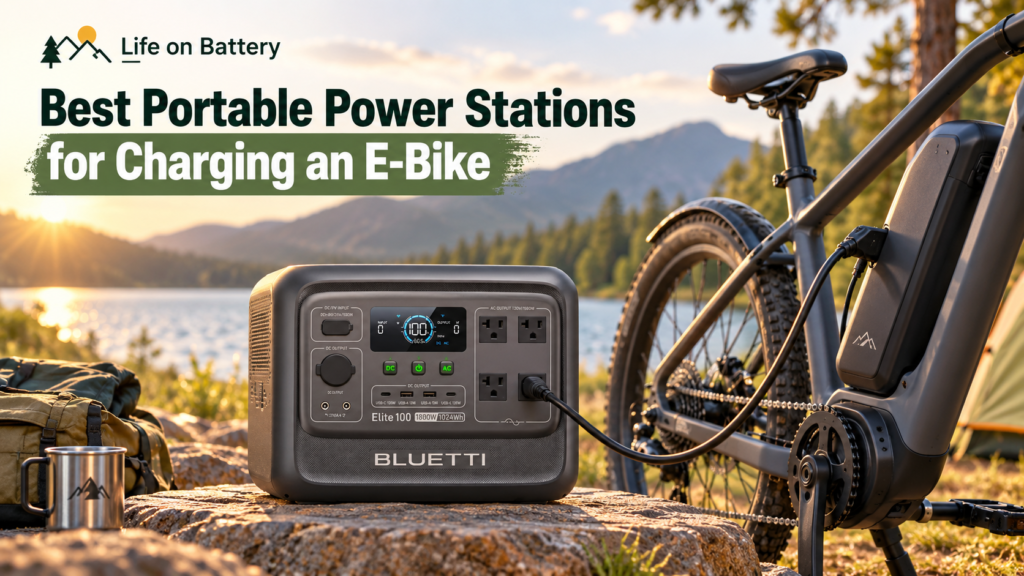
Looking for the best portable power station for charging an e-bike? The right power station can give you a practical way to recharge away from a wall outlet — whether you are camping, traveling in an RV, dealing with a power outage, or simply want backup power available at home.
But not every portable power station is a good match for an e-bike. Battery capacity, AC output, charger compatibility, weight, recharge speed, and usable energy all matter.
In this guide, we’ll compare portable power stations based on manufacturer specifications, published documentation, capacity, power output, portability, and suitability for e-bike charging. We have not personally tested every product listed, so we will clearly distinguish published specifications from hands-on experience.
A good starting rule is that the power station should have enough continuous AC output to run your e-bike’s original charger and enough stored energy to provide the amount of charging you need.
What Size Portable Power Station Do You Need for an E-Bike?
The right size depends mainly on your e-bike battery capacity and how much of a recharge you want from the power station.
E-bike batteries are usually rated in watt-hours (Wh). A common battery might be around 500 Wh, while larger e-bikes may use 700 Wh, 750 Wh, or more.
A portable power station should have more stored energy than the e-bike battery you want to recharge because some energy is lost while converting DC battery power to AC and then back through the e-bike charger.
For example, a 500 Wh e-bike battery will generally require more than 500 Wh from the power station for a complete recharge. A power station around 500 Wh may provide a substantial partial charge, while something in the 700 Wh to 1,000 Wh range gives more breathing room for a fuller recharge, depending on efficiency and the starting charge level.
A larger power station can also be useful if you want to charge other equipment at the same time, such as phones, lights, laptops, or camping gear.
Capacity is not the only specification that matters. The power station’s continuous AC output also needs to be high enough to run your e-bike charger safely.
BLUETTI Elite 100 V2 — A Strong 1,024Wh Option
The BLUETTI Elite 100 V2 is a compact portable power station with 1,024Wh of battery capacity and 1,800W of AC output, making it a practical size for charging many e-bike batteries while still being portable enough for camping, road trips, or backup power.
BLUETTI uses a LiFePO₄ battery in the Elite 100 V2. The unit weighs about 25.3 pounds, which is relatively manageable for a power station in this capacity range.
For e-bike charging, the important numbers are the 1,024Wh capacity and 1,800W AC output. That output is well above the power requirement of most standard e-bike chargers, while the battery capacity provides enough stored energy to give many typical e-bike batteries a substantial recharge away from a wall outlet.
Keep in mind that you will not get the full 1,024Wh delivered to an e-bike battery. Some energy is lost through the power station’s inverter, the e-bike charger, and the charging process itself.
BLUETTI also rates the Elite 100 V2 for up to 1,200W AC charging, reaching about 80% in 45 minutes under specified conditions, and it supports up to 1,000W of solar input.
Best for: Riders who want enough capacity for e-bike charging while keeping the power station reasonably portable.
How Much AC Output Does an E-Bike Charger Need?
Most e-bike chargers use far less power than large household appliances, but the portable power station still needs enough continuous AC output to run the charger comfortably.
A typical e-bike charger may draw somewhere around 100 to 300 watts, depending on the battery system and charger. Faster chargers can require more power.
For that reason, a portable power station with at least 300 to 500 watts of continuous AC output will cover many common e-bike chargers, while a higher-output model gives you more flexibility for larger chargers or for powering other devices at the same time.
The key number to compare is the charger’s input wattage or electrical input rating. You can usually find that information on the charger label or in the e-bike manufacturer’s specifications.
It is also smart to leave some extra headroom instead of choosing a power station whose maximum output exactly matches the charger’s requirement.
Best Portable Power Station for Charging an E-Bike
The best portable power station for an e-bike should combine enough battery capacity for a useful recharge with plenty of AC output for the bike’s original charger. Portability matters too, especially if you plan to carry the unit in a vehicle, RV, or camping setup.
We are focusing primarily on power stations around the 1,000 Wh class because they provide a practical balance between capacity, output, and portability for many common e-bike batteries.
The products below are compared using current manufacturer specifications and published product information. Prices and configurations can change, so we will focus on the specifications that matter most for e-bike charging.
Jackery Explorer 1000 v2
The Jackery Explorer 1000 v2 is a strong match for e-bike charging because it combines a 1,070 Wh LiFePO₄ battery with up to 1,500 watts of continuous AC output. That is considerably more AC output than most standard e-bike chargers require.
Its roughly 1 kWh capacity also gives it enough stored energy to provide a substantial recharge for many common e-bike batteries, although actual charging results will depend on the bike battery size, starting charge level, and conversion losses.
Jackery lists the unit at about 23.8 pounds, making it relatively portable for a power station in this capacity range. The LiFePO₄ battery is rated for thousands of charge cycles, which also makes this model relevant for people who expect to use their power station regularly rather than only during emergencies.
Good fit for: camping, RV travel, e-bike trips, emergency backup, and riders who want roughly 1 kWh of portable energy without moving into a much larger power station.
EcoFlow DELTA 3 Classic
The EcoFlow DELTA 3 Classic is another strong option for e-bike charging. It has a 1,024 Wh LiFePO₄ battery and 1,800 watts of continuous AC output, giving it plenty of power for most standard e-bike chargers.
Its roughly 1 kWh capacity puts it in a useful range for riders with common 500 Wh to 750 Wh e-bike batteries. A complete recharge will still involve conversion losses, so the exact amount of battery capacity you recover will depend on the e-bike battery size and starting charge level.
EcoFlow lists the DELTA 3 Classic at about 26.7 pounds, so it is somewhat heavier than the Jackery Explorer 1000 v2 but still practical for vehicle, RV, campsite, or garage use. It also supports up to 500 watts of solar input, which may be useful for riders who spend extended time away from household power.
Good fit for: e-bike charging, camping, RV travel, emergency backup, and users who want higher AC output from a roughly 1 kWh portable power station.
BLUETTI Elite 100 V2
The BLUETTI Elite 100 V2 is another strong roughly 1 kWh option for charging an e-bike away from a household outlet. It has a 1,024 Wh LiFePO₄ battery and up to 1,800 watts of AC output, which is far more than most standard e-bike chargers require.
BLUETTI lists the unit at about 25 pounds, putting it between the Jackery and EcoFlow models we’ve looked at for portability. It also supports up to 1,000 watts of solar input, which could be useful for longer camping or off-grid trips where riders want to replenish the power station during the day.
Like the other models in this guide, the amount of charge it can deliver to an e-bike will depend on the bike battery’s size, starting charge level, and normal conversion losses.
Good fit for: camping, RV travel, e-bike charging, off-grid use, and riders who want a compact 1 kWh-class power station with strong solar-input capability.
Which Portable Power Station Is Best for Your E-Bike?
The best choice depends on how you plan to use the power station and what matters most to you.
Choose the Jackery Explorer 1000 v2 if portability matters most. At about 23.8 pounds, it is the lightest of the three models in this comparison while still providing 1,070 Wh of capacity and 1,500 watts of AC output.
Choose the EcoFlow DELTA 3 Classic if you want more AC output. Its 1,800-watt output provides plenty of headroom for an e-bike charger and other equipment, while its 1,024 Wh battery keeps it in the same general capacity class.
Consider the BLUETTI Elite 100 V2 if you want another compact 1 kWh-class option. Its specifications put it in the same general category as the Jackery and EcoFlow models, making it worth comparing once current pricing and available bundles are considered.
For most e-bike owners, there is no need to choose based on maximum AC wattage alone. Even the 1,500-watt Jackery provides far more output than a typical e-bike charger requires. Capacity, weight, price, charging options, warranty, and how you plan to use the power station are likely to matter more.
Before buying, always compare the power station specifications with the input requirements printed on your specific e-bike charger.
Can a 1,000 Wh Power Station Fully Charge an E-Bike Battery?
In many cases, yes. A portable power station with around 1,000 Wh of capacity can provide a full recharge for many common e-bike batteries, especially batteries in the 400 Wh to 750 Wh range.
However, you should not assume that a 1,000 Wh power station will deliver a full 1,000 Wh to the e-bike battery. Some energy is lost through the power station’s inverter, the e-bike charger, and the charging process itself.
For example:
- A 500 Wh e-bike battery should generally be a comfortable match for a 1,000 Wh power station.
- A 750 Wh battery may still be able to receive a full charge, but there is less extra capacity left over.
- A battery close to 1,000 Wh may not receive a complete recharge from a 1,000 Wh power station because of normal conversion losses.
The starting charge level also matters. If your e-bike battery is already partly charged, the same power station may be able to top it off multiple times before needing to be recharged itself.
This is why a power station in the 1,000 Wh class can be a practical choice for many e-bike owners without becoming excessively large or heavy.
Can You Recharge a Portable Power Station With Solar While Traveling?
Yes. Many portable power stations can be recharged from compatible solar panels, which can be useful for camping, RV travel, and longer trips where household power is not always available.
Solar charging speed depends on several factors, including the power station’s maximum solar input, the wattage of the solar panels, weather conditions, panel angle, temperature, and how much sunlight is available during the day.
A power station that accepts 500 watts of solar input may recharge much faster than one limited to 200 watts, but the actual amount of solar power collected is often lower than the panel’s maximum rating because real-world conditions are rarely perfect.
For e-bike riders, solar charging can help replenish the portable power station during the day so that stored energy is available later for charging the bike, lights, phones, or other equipment.
Before connecting solar panels, make sure the panel voltage and connector type are compatible with the power station. Use the manufacturer’s approved specifications rather than assuming any solar panel will work safely.
What Should You Look for Before Buying a Power Station for an E-Bike?
Before buying a portable power station for e-bike charging, compare the specifications that actually affect how well it will work with your bike.
The most important things to check are:
- Battery capacity: Look at the power station’s watt-hour rating and compare it with your e-bike battery capacity.
- Continuous AC output: Make sure the power station can comfortably run your e-bike’s original charger.
- Weight and portability: A larger power station may provide more energy, but it can also be much harder to carry.
- Recharge options: Consider whether you want wall charging only or also vehicle and solar charging.
- Battery chemistry: Many newer power stations use LiFePO₄ batteries, which are designed for long cycle life and frequent use.
- Number of outlets: Extra AC outlets and USB ports can be useful if you also want to charge phones, lights, laptops, or camping equipment.
- Warranty and support: A portable power station is a significant purchase, so warranty coverage and manufacturer support are worth comparing.
It is also important to remember that a higher wattage rating does not automatically make one power station better for an e-bike. Once the unit has enough AC output for your charger, capacity, portability, price, and charging options often become more important.
Frequently Asked Questions About Charging an E-Bike With a Portable Power Station
Can any portable power station charge an e-bike?
Not necessarily. The power station needs enough continuous AC output for the e-bike charger and enough battery capacity to provide a useful amount of energy. Always compare the charger’s input requirements with the power station’s specifications.
Can I plug my e-bike charger directly into a portable power station?
Yes, in most cases you can use the e-bike’s original charger with the power station’s AC outlet, just as you would with a household outlet. This is usually the safest and simplest method.
How many times can a 1,000 Wh power station charge an e-bike?
It depends on the size of the e-bike battery. A smaller 400 Wh or 500 Wh battery may receive more than one substantial charge, while a larger 750 Wh battery will use much more of the power station’s stored energy. Conversion losses also reduce the amount of usable energy.
Can I charge an e-bike from a power station while the power station is charging from solar?
Some power stations support charging devices while the station itself is being recharged, but the exact behavior varies by model. Check the manufacturer’s specifications for pass-through or simultaneous charging before relying on that feature.
Will using a portable power station hurt my e-bike battery?
Using the e-bike’s original or manufacturer-approved charger with a compatible portable power station should not normally change how the e-bike battery is charged. The e-bike charger and battery-management system still control the charging process.
Is a portable power station worth buying just for an e-bike?
It can be, especially for riders who camp, travel, use an RV, experience frequent power outages, or want backup power for other devices as well. If the power station will only be used occasionally for one e-bike, the cost and weight may be harder to justify.
Bottom Line: Choosing a Portable Power Station for Your E-Bike
A portable power station can be a practical way to charge an e-bike when a household outlet is not available, but the best choice depends on your bike, your travel habits, and how much backup power you actually need.
For many riders, a power station in the 1,000 Wh class offers a useful balance of capacity, portability, and AC output. Models such as the Jackery Explorer 1000 v2, EcoFlow DELTA 3 Classic, and BLUETTI Elite 100 V2 all provide enough AC output for most standard e-bike chargers while offering enough stored energy for a meaningful recharge.
The most important thing is to compare the power station with your own e-bike charger and battery. Look at battery capacity, continuous AC output, weight, recharge options, warranty, and how you plan to use the unit beyond the bike itself.
If you camp, travel by RV, experience power outages, or want backup energy for other devices, a portable power station can serve several purposes instead of being a single-use purchase.
Related reading: Learn how long it takes to charge an e-bike battery and how long an e-bike battery lasts.